Friday, July 12, 2013

MARCOS CHIN + BLACK HILL PRESS


Here is a project that I worked on recently with Kevin Staniec at Black Hill Press. Kevin called me several months ago to ask if I would like to collaborate on a series of book covers for one of their series (of books). Black Hill Press is an independent publishing house dedicated to the novella - a distinctive, mid-length fiction. Part of the reason why I chose to collaborate was because of my own interest in writing; I've not been formally trained in the craft, and really my doing so, was for my own pleasure. Initially, I was intending to only post the final covers, but then decided midway through preparing the files to upload online, that I wanted to show some of the process as well. Much of my blog is devoted to the creative process that I experience in my studio, the psychological, emotional and critical challenges that I  face through my art-making. However, this time I thought it would be interesting to share some of the lead-up sketches and preparatory drawings that I created up to, and including the final illustrations. Kevin and I spoke a good amount about each of the stories, and our dialogue helped shift and guide my approach to the covers. Although I did not read the novellas in their entirety, it was still important that each one of the images be endowed with its own "spirit," while still being connected to one another. As an Illustrator, I believe it's paramount to be aware of those qualities about one's work that makes it special and stand out from his/her peers. In my case, I know that colour, a graphic composition, and creating patterns through the repetition of shapes and objects have become my visual communicators. The challenge then, was how to let go enough and to brainstorm in way that would make the images convey a kind of genuine feeling, rather than seeming as though they were formulaically constructed based on the conversations that Kevin and I had about each cover, as well as the judgements that I had about my own work. When I begin a project, I go into a kind of free fall, (thumbnail) sketching every idea onto the page, while still being very aware of what I am visually trying to communicate - yeah, I'm free-falling but I still keep an eye out for where I'm supposed to land.  It's a conceptual purge in a way, and for me, speed is important, so is rhythm, and so I have to use a tool such as a marker to draw at this stage. This method gives a heavy nod to automatic drawing, ala the Surrealists, not necessarily having one's subconscious inform the marks that one makes, but rather allowing oneself to freely draw without judging or editing oneself. Eventually, I have to trust myself enough to know that even though it may seem like a struggle moving towards the final destination, I understand that as I continue to draw, I will eventually arrive to the right place.


Wednesday, July 3, 2013

Studio Visit with Joshua David McKenney + Pidgin


Yesterday I attended a studio visit with Joshua David McKenney: artist, designer and now creator of “Pidgin” his modern take on the classic European doll. We sat down in his home and studio, cracked open a bottle of Lambrusco Rosé, and dreamt aloud;  we spoke about art and design, doll-making, illustration, creative transition, Mel Odom, Antonio Lopez, Jane Forth, food, and Olive Oil.
As an Illustrator, I spend much of my time alone in the studio, but occasionally I manage to get out and roam the neighbourhoods, stumbling upon goodies that feed my eyes and spirit. I’ve read many artists’ biographies and interviews in which they discuss their creative re-engagment with whatever discipline is their focus (when I use the term artists, it encapsulates all kinds of artful things, such as writing, music, illustration, hair, fashion, etc.). For me, it’s the stories of others, seeing and hearing about their processes, not only in reference to making whatever (art) piece they are making, but also the lead up and arrival to that aforementioned work. It felt kind of like a denouement seeing Joshua again after several years, and meeting Pidgin for the first time. I remember reading about both successes and failures while he was making this doll -- melted faces especially (the head, arms and legs are porcelain and so they have to be fired in a kiln) and so, I related to it much the same as any other individual who is close to whatever it is that s/he is making – and that thing which is being made carries within it all of the artist’s greatest hopes and intentions. Seeing Pidgin manifest in front of me was incredibly surreal, and inspiring. You can meet Pidgin at www.pidgindoll.com


Monday, June 24, 2013

YEE YEE + Renegade Craft Fair, part 2


Photos by Isabelle Derveaux
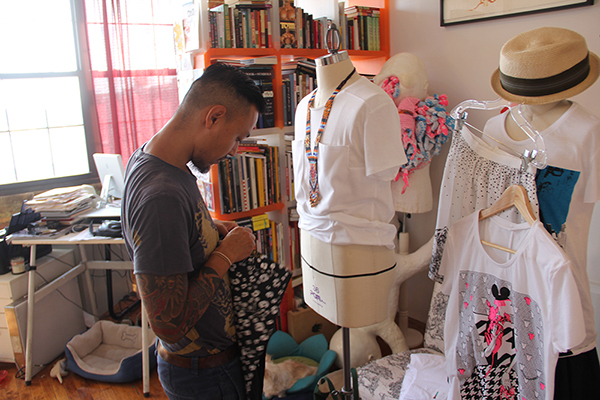
Last fall I chose to give my personal T-shirt project a chance; the line is called YEE YEE. It’s a thought that had been steeping in my brain for about two years, but I wasn’t sure that it was something  I wanted to pursue for several reasons mainly because I lacked the time that it would take to learn a new skill. So much of my life is spent drawing. It's become such a ritual for me, that I do it almost every day without question. But when I chose to enroll in my first sewing class at the Fashion Institute of Technology over a year ago, the time that I spent drawing became challenged by the time that I spent learning a new skill because I knew that if I wanted to become better at it, then I would have to spend time nurturing it. By the end of last Fall, I had completed two classes at FIT in sewing and draping, and partially completed a third class in pattern-making. Each time I finished one class and began another, I fell in love even more with the process and craft of making clothing. I admit that this made me nervous because the emotions I felt while cutting and sewing reminded me very much of when I was a child making art. This sounds like a strange thing to admit, but my worry about enjoying sewing meant that I would now need to build time into my schedule to accommodate more of it. And quite frankly, I'm a person who tends to spread himself too thinly as it is, already.

Yesterday I participated in my first public craft fair: The Renegade Craft Fair in Brooklyn. Over the past year, I’ve created modified Tshirts that I’ve cut, sewn, and printed in my studio, in Brooklyn. Much of it was enabled through the knowledge I had acquired via my classes at FIT, as well as the time I spent researching online and in books to acquire information that I wasn't taught in school. I also spent several months last year interning for a fashion designer in New York, where I met her assistant who I eventually hired for a few weeks to help me sew a few things. She, above all became a huge saving grace for me; having spent more than 30 years as a sewer in factories in China and in New York, she taught me things that I really don’t believe I would have ever learned in school. She streamlined my process, shared with me her knowledge and experiences in the industry, and questioned the intentions of my work. She spoke to me about manufacturing, mass production, and suggested various ways I could approach my craft. She asked me questions, many questions, and called me on my own bullshit time and time again.

I confess that over the past few months I've been wondering if I should continue making my T-shirts; to carry on, and to expand my body of work within this discipline. I think more than anything else, it was becoming a situation in which I was making things and then putting them off to the side as personal items that very few people would physically see, or touch, or pay any attention to. I wonder if part of me kept these things to myself because I was unsure about how they would be received. As someone who is just learning a new craft, it’s terrifying to put your work out there for others, for fear rejection mostly. Admittedly, when I was first starting out as a young Illustrator, I made many mistakes, to the point in which I’m sure that some clients would never want to work with me again. Not because of any type of personality clash, but moreso because of the quality of my work, or lack thereof. I reflect a lot on my workmanship in reference to my sewing; that each time I create a new T-shirt for example, I believe it’s better than the previous one, and so it makes me want to reach out and replace the one that somebody has already bought. But then I stop and realize that this is just part of the creative process: wanting to improve, and knowing that one's work will become better over time through repetition, practice and effort. We’re not born experts, none of us are. Sure, some of us are fortunate to be blessed with extraordinary dexterity within a particular discipline; some are born into families who are supportive, some wealthy even, who can help make the path to realizing one's artistic dreams much easier than if it were otherwise the case. But in the end it’s really about the level of commitment that one has with making one’s art, or design, or drawings… or T-shirts which needs to firmly exist if s/he is to keep forging ahead.

I wasn’t sure what it was that I wanted to write about this morning, only that I knew I had to share my experiences from The Renegade Craft Fair. It was an incredible weekend, and the first time that I’ve ever displayed this particular work of mine in such a public way, to both strangers and friends. I’ve been trying to recognize the difference between this event, versus my experiences participating in an open studio or (gallery) art show. If I distill it into its most simplest form, it’s really quite the same: I’m sharing my work with an audience, which may or may not respond favorably to it. However, there was something very different about this event, and I wonder if it had more to do my wishing for some kind of sign or response, which would encourage me to continue.

I wanted to thank you for everyone who came by; friends and strangers who said hello, the conversations that I had with you, the exchange of inspiration, and creativity; the openness of those who I spoke to, who wondered out loud, and the encouraging bits of wisdom and advice that I received. You are all incredible. 

* the photos above are courtesy of Isabelle Derveaux, Illustrator - Photo Organizer.

Sunday, June 16, 2013

YEE YEE + Renegade Craft Fair, part 1


photos by Steven Chu
I've been working on creating a few new Tshirts to sell at the Renegade Craft Fair in Brooklyn, this weekend June 22 & 23; here are the latest ones. I've expanded my Love Is Cool collection to include a "Full Floral T", and also a "Big Heart Tank." I'm heavily shifting towards prints and pattern; I feel this makes sense being an Illustrator, but also, I'm a lot of fun doing it. Below are some photos that were taken by the artist Steven Chu.We collaborated to come up with some ideas that were strangely, playful and beautiful. I created the props using paper and foam core board, and then silkscreened my prints onto them. Also, I created some sculptureal pieces that were cut, sewn and stuffed to created a kind of visceral toy chain, in one of the shoots. Thank you to Mikee and Glenn who were amazing models. The shoot was not easy! But it was fun! Thank you also to Santos party house for lending us the space. The Brooklyn Renegade Craft Fair is on Sat + Sun, June 22 + 23, 11:00am-7:00pm in East River State Park, on North 8th Street, and Kent Avenue. I'll be selling some of my Tshirts and silkscreen prints. I hope to see you there!

I recently had the privilege of being interviewed by Peggy Roalf for DART through American Illustration and American Photography (AI-AP). It was a Q & A about my work and process in reference to my commercial and personal work. Link to ai-ap.com to read interview. And many thanks to Glenn Lovrich for photographing me at work in my studio.

Tuesday, May 28, 2013

Commitment
Last night I watched a documentary called Fame High. The movie followed the lives of four students who attended the prestigious (performing) arts high school, Los Angeles County High School for the Arts (LACHSA).  One of the students, a dancer named Grace Song, said near the end of the documentary about needing to commit to one’s art (and craft) everyday. This statement felt very profound to me because it encapsulated in a few words, much of what I’ve been trying to do over the past several years via my studio practice, but haven’t been able to articulate in such a succinct way.

Each morning I arrive to my studio very early, and begin my day. It’s quiet. I like the quietness. It allows me to center to myself so that I can move forward doing the tasks that I’ve assigned myself. It’s not always commercially related, but personal projects as well. I’ve wondered many times over the reasons why I continue to work on these self-initiated pieces instead of just taking the time off to do other things that I like such as going to the gym, exploring the city, and seeing friends; I mean, these personal projects of mine don’t result in any sort of tangible return, they don’t necessarily elevate my professional practice in an immediate way, there’s oftentimes no audience, nor do they inspire any kind of reward that would directly boost my career. For the most part, my personal projects allow me to manifest those ideas that I have floating around in my head; to give shape and form to my content. However, after watching the documentary I realized something new: that my decision to work, when there’s no work, to draw when nobody is telling me to draw, to sew when there is no reason for me to sew is because it encourages me to re-commit myself to my art and to my craft of making things.

To re-commit doesn’t mean that I’ve fallen out of love with what I’ve done and need to proclaim my reconnection to it, rather re-committing simply means that I continue to love what I do, and through this love helps me to see the importance and neccessity of the work (which is oftentimes repetitive in nature) and the discipline that is required if I want to continue to make this (art) a long and fruitful part of life. I know how easily it can be to become lazy and bored of drawing. I know how easy it can be to feel like giving up, to find excuses to see the worthlessness in wanting to create something that will undoubtedly be judged by others (for better or for worse); and if it’s for the worse, then why bother? I understand how challenging it can be to stay motivated. But I realize that going into my studio each day, and leaving each night is a form of the commitment that I’ve made to the art that I create. I tell myself all the time, that talent can fade; that this talent can leave me if I refuse to nourish it – the creative process that I experience everyday is really a creative ritual of commitment that I choose to practice every time I step inside my studio.

Thursday, May 9, 2013

Talk at the Apple Store, Grand Central Terminal
I'll be giving at an hour long talk at the Apple Store, Grand Central Terminal tonight at 7:00pm. It's free and open to the public! Hope to see you there! www.apple.com/grandcentral

Saturday, May 4, 2013

RUN
"Nature Boy," for Runner's World magazine

I’d forgotten how many memories are held within my muscles; that after years of having not done a certain type of movement or walked along a certain type of terrain, how my body remembers, and then I wonder if it aches for these things as well.
This morning I went for a run at 6:30am. It wasn’t planned; I just woke up and decided to go.  My neighbourhood looks different in the morning -- there’s a sleepiness about it that I enjoy.  During the day, it’s cramped and loud and at times very aggressive, but at this hour the blocks that surround my apartment exist within a kind of in-between : dusk and dawn, slumber and wakefulness, even the air that touches my skin feels like a blend of both cool and warmth. I don’t run outside very often, much of my running is done on a treadmill and although I think a lot about many things while I’m doing this, today felt different because today I was remembering.
I reached the track about 2 miles from my apartment and decided to run a few laps around it to increase my distance. I have an app on my phone that records the details of my run; traveling from my apartment to the track, and then around it four times, and back home equates to about five miles. The track circles a soccer field, and especially in the spring and summer time it livens with people playing sports, exercising, or sitting on the grassy areas nearby. When I ran along it this morning, I remember what it was like running on a similar track as a child.
It’s a strange sensation when present experiences recall past ones that can make those memories seem almost tangible. When I stepped onto the track, I felt a rush throughout my body, like I had set foot into a brand new world. I could feel the rubber track of the surface push against the soles of my shoes into the bottoms of my feet and then surge upwards into the rest of my body.  I began running faster and felt my posture change slightly, as I rounded back my shoulders and glided forward.  My breath pulsed out from between my lips and  I saw the bands of white on the surface to the left of my feet, and so I ran as close to it as possible without stepping over the line. As I rounded the corners, I tilted sideways slightly, and felt the muscles in my ankles and thighs engage, and strengthen.
I ran faster.
The last time I ran on a track like this was when I was fourteen years old, and competing in a relay race. I was the third runner in my leg of the race, and our team was competing against the other schools within our district. We spent hours after school practicing for this moment; building each other's spirits, learning the rules of the course, how to run more efficiently, and ways to pass the baton seamlessly to one another to sustain the team’s rhythm. We wore our school uniforms, which were blue, white and silver, and I competed on a huge track in the middle of a stadium surrounded by student competitors from other schools. I remember the feeling of exhilaration as I stood on my mark, waiting for that moment until I felt the cold piece of metal in my hand. And when I did, I launched forward into infinite, and I don’t think that I thought about anything else at that moment except for running.

Friday, March 1, 2013

Colour

I use colour in a lot of my work. This was not always the case. When I applied to art college, much of the work in my portfolio lacked colour. Colour mixing, and arranging colours together was for me, not very intuitive.  When I was in my foundation year, I enrolled in a colour theory class - it was a mandatory class, and my instructor's name was Renata Realini. She studied at the Bauhaus and brought her knowledge and expression of colour into the classroom. I have to confess that as a student, I felt as though the exercises were not very interesting, but in retrospect, I realized that this particular skill set could only be truly understood through practice. The assignments ranged from ones inspired by Johannes Itten's book "The Elements of Color," and also exercises from Josef Albers; mixing and painting coloured squares and placing them next to each other to see how colours changed depending on whatever they were adjacent to, and also, how its temperature would change depending on its position amongst other colours. We used colour to flatten three dimensional space, and made our own Vasarely grids to create optical effects. It was exercises on top of exercises, and although I was not able to see what was happening per se, my senses were slowly becoming attuned to this artistic element. 

I've been asked by many students how I use colour, and how they might possibly become better at using it. When I hear this question, I rephrase it in my mind into something similar to this:
"I'm afraid of using colours. There are so many colours out there, so how do I decide which ones to use? And how do I know which ones work best together?"
I think for someone who is beginning to explore colours, but is a bit nervous to do so, taking small steps by giving oneself restrictions can be a good thing; meaning that working with a limited colour palette, for example only 2 colours that are similar (or monochromatic) and then perhaps using third colour, as a highlight is a non-intimidating way to begin. How to choose these two colours is up you. Honestly, I'm one who enjoys keeping things playful in my studio, and although I do have colour touchstones (in other words, my go-to colours) frequently, I choose a colour based on the mood that I'm trying to create within a scene. For example, if it's a sad scene, then I might use cool colours, such as blues and turquoises. Or, if it's a scene that is bold and perhaps even aggressive, I may use reds, and solid blacks. As an illustrator my intention isn't only to render subject matter, but to also create moods and atmospheres. It's important for me to engage as many of the viewers' senses as possible, not only the obvious one, sight, but smell, sound, taste, and touch; colour for me is a good way to appease those senses. Once I decide on the mood of the piece, it will lead me towards selecting a base colour, or starting point. In the piece, "Death on Facebook," for The Atlantic, I chose to use blues as my foundation colour because of the topic of the article. A woman learns via Facebook, that an acquaintance of hers has died. Although there could have been other ways to approach colouring this piece, I chose to use blues and cool tones because I felt that these colours would best represent silence and the feeling of sadness. For my drawing "Scars," also for The Atlantic, the story was a fictional piece about a woman who has a mastectomy, and decides to tattoo this area of her chest with flowers. When I read this story, I gravitated towards the hopefulness, beauty and strength of the character. I asked myself, how can I make this piece both strong and beautiful using subject matter (flowers) which are typically aligned with a kind of fragile and ephemeral beauty? My answer to this, was to make the flowers bold while keeping the delicateness of them intact. The repetition through the clustered arrangements of the flower create a kind of soft armor that the woman sits in. 
"Death on Facebook," The Atlantic

"Scars," The Atlantic

I feel that it's okay to look at other artists' colour palettes (in various artistic disciplines) and apply those colours to one's own work. Again, when you're at the beginning stages of your career, you are still learning, and so by referring to other artists' colour palettes it will help you to understand the relationships between these colours. Eventually you will arrive to a point where you will have the confidence to adjust your colour palette, by adding or taking away particular colours so that the process will start to become more intuitive. I oftentimes refer to old prints, posters, and book covers for colour inspiration. My very good friend, Yuko Shimizu, describes the reasoning behind doing this as being a sound way to edit one's colour selection. When these posters and prints were created they were done using old printing methods, and so their limitations forced them to use only a few colours within an image. Oftentimes, I find that students are overwhelmed with colours, they see so much of it, and find it difficult to make a decision. Editing is the key, and referring to these modes of inspiration is only one way of establishing a starting point when deciding how to approach using colour in one's work. 


Another thing that I enjoy doing is drawing in colours, instead of using only black, or grey. Although this may be a psychological trick that I play on myself, it has become one of the best methods for myself, that has improved my colour sensitivity. Again, I would only limit myself to a maximum of two to three colours, and then use those colours to draw. Usually I would choose a warm and cool colour, for example a magenta and turquoise, where the turquoise acts as the cool value typically used for shadows. Choosing to remove black from my toolbox when sketching, forced me to work with the colours that I would have on hand, thereby making me less fearful (of using colour.)

What I've written has really been informed through my own experience, through trial and error, and was inspired by a recent question that I received from a student who asked about my colour use, and suggestions on how he could better his own. My approach reads as kind of formulaic and linear, but really I believe that colour is best understood when used with a kind of abandon. Learning by doing and experimenting is by far, in my opinion, one of the most effective ways to understand the properties of colour. 

Friday, February 22, 2013

Illustrations for Target in Canada
For the past few months, I've been working with Target and the advertising agency KBS+P in Toronto, to create ads for Target's debut in Canada. Today they released news for the first time; glimpses into what to expect from their launch. Here are a couple links to more images and news at Marketmag.ca, and another from The Toronto Star. Stay tuned for more fun bits as the ads begin to roll out! 

Tuesday, February 19, 2013

Vasovagal

I fainted last night.
I fainted in front of my students, while teaching in class.
I was unconscious only for a short period of time, at least that's what I was told.
Only a few seconds.
I have no memory of it even happening; it felt as though somebody hit the power-off switch in my brain, and I suddenly collapsed. Not to diminish the experience but shortly before regaining consciousness, I had what I think was a dream -- and Britney Spears was in it.
Mikee said that she was my sprit guide?
I always thought that if I did have any kind of spirit guide it would be someone like Zora Neale Hurston or someone with the voice of Maya Angelou, or Toni Morrison.
While I was unconscious, Britney never spoke to me, but I wonder had she done so, if the voice of Ms Angelou would have come out of her lips.

~


Before going to sleep last night, I asked myself what I was supposed to learn from this experience. I sometimes do this; if there is a question which needs answering, I ask myself this question over and over again, until I fall asleep. 

I woke up with an answer.
Well, more like a question,

Think of all the things that you have in your life and how much they're worth. 


I'm 38 years old, and in what I believe is the best health that I've been in over the past 7 years. 

Although, I'm no spring chicken, I do believe it was chicken that may have been the catalyst for my all-day-nausea, and eventual fainting spell in the evening.


I wonder if I had been under for a few seconds longer what Britney would have said?


Saturday, September 29, 2012

The Reminder


For the past several weeks, I've been working on refining some modified T shirts that I designed. I've been wanting, for a very long time, to venture into fashion - not as a career shift, but moreso to introduce this as another component to my studio practice. Many people have asked me in reference to my wanting to create cut & sew T shirts, why I don't purchase them from a manufacturer and then silkscreen my images onto them. It's a legitimate question, and one that I think comes up naturally in reference to me because I am an illustrator, whose strength is rooted in drawing. Sewing for me, is still very new; although I do love the process of it, I still have much to learn. And so, after answering out loud (and to myself) this question many times over, I realized that my choice has less to do with practicality at this point, and everything to do with realizing a dream. I've written these words before:  
I love the craft of making things. 
I care about my studio practice.
This is not to suggest that I would never source out part of my work; I would be stubborn not to do so, if ever the demand became too large for me to manage. To share, I currently have a sewer, and an assistant, as well as interns who have helped me tremendously throughout this process. But at this point, if I continue to receive help and source out more of my process, then I would want to keep the manufacturing within the US. So far, it's been good, and so far I've been able to afford to do so. But I admit that I am spending more than I am making. And in order to make these shirts, and in order to shift some of my time and attention over to creating these shirts, means that I have to give up other things. I've always believed that everything comes at a price, that when you ask for, and then receive something, then you must relinquish something else in return. To do otherwise, inspires greed and self absorption, two characteristics that I despise in people. The notion of give-and-take is something that I take very seriously; for me, nothing is free.

The past two weeks I have been working more than 90 hours per week. 
I write this, not because I am proud. It's only a statement to describe the effort that it's taken me to try to do all of the work. For me, the work was necessary, because choosing to do it any other way, would not have been possible, at least with my current resources and income.
Over the past 14 or so days, I had a kind of daily ritual: I would wake very early in the morning, between 4:15am to 5:00am; I would shower and get changed, and then walk the dogs to the studio. Rita, who is the older of the two dogs,  I would carry most of the time -- without trying to humanize her, I figure that it's probably too early for her to walk based on the fact that she just sits on the sidewalk when we get outside. In any event, my work days have been lasting between 12-16 hours everyday, including the weekends, such that I split my days up to accommodate both illustration and fashion related work.
It's a strange feeling to work so hard for something and then arrive at a place where you suddenly forget the reasons why you began in the first place. It's the repetition of tasks, and those moments when I spend alone in silence, making whatever it is I am making without any feedback from anyone that causes me to forget what my original intentions were for choosing to place so much time and effort in making these T shirts. 
And so, I find myself 
pausing, 
and listening, 
and watching 
for some sign to remind myself that all of my pursuits carry with it good intentions, and contain some value of worth.

* The T shirts above are from my line YEE YEE. My focus for the Fall are on Graphic Tees. They're currently on sale on fab.com.

Tuesday, September 4, 2012

Process Silkscreen 02: Creating Transparencies

Oooops. I made a mistake. No worries. I'll fix'em up.
Process Silkscreen 01: Creating the Transparencies.


I've been silkscreening a lot in my studio. Here's part of my process creating the transparencies. Again it's totally DIY-improvise. I'm still wonky. I'm still a newbie, but I'm finally starting to get results that I'm happy with. Enjoy.

Thursday, July 26, 2012

Twyla Tharp, The Creative Habit
I'm reading Twyla Tharp's "The Creative Habit."
I've only just begun.
I read constantly, blips and blurbs from this book and that. Sometimes I take what I need from one source and then put it down. After which I pick up another book, and read bits and pieces from that. Sometimes I finish it.
Other times I don't.
I've taken the pressure off of my having to finish every book that I start perhaps because the work that I do on a daily basis is so deadline driven. As a commercial artist, I must finish everything that I start because if I don't, then it will begin to affect others who are involved in the process; the editors, the art directors, the clients, and the purchasers of whatever service or product my illustrations are connected to.
But this book, even though I've only just digitally swiped open, feels different.
A lot of what I've been doing in my studio recently has been related to the building of my skill and dexterity. The repetitiveness of my process feels new to me only because it is so new. I'm referring to the cutting and sewing and silkscreening that has been so prevalent in my practice since early this year. I think that having been immersed in Illustration since art college, it's  slowly eroded away the obvious challenging feelings that can accompany the building up of skill within a creative discipline until they become, as Twyla Tharp suggests, habits.
Her words have already begun to affect me in a way that a good conversation can with a friend, or mentor.
I think part of me is always in search of a mentor, but I find it more difficult as I get older, for whatever the reasons may be. Perhaps it's my inability in not knowing how to do so, being shy or fearful about it, or maybe through my own experiences I've concretized my own way of thinking, and so I've built up a resistance to suggestions that don't match my own -- some would call this stubbornness... I call this stubbornness.
Or maybe it's just a logical tendency to become this way after several years of working within the same creative discipline; as one gains more experience in whatever field he or she specializes, there is less of a tendency to ask others for help, and more movement towards sharing knowledge with those who have less experience.
The books that I read have oftentimes become the sources that I tap into whenever I need advice, direction, or solace. I'm particularly inspired by the experiences of others in fields which lay outside of my own. This is not meant to sound arrogant, but I do believe in the importance of having a holistic approach to one's art practice, and that means being open to the ways that others (who's professions are unlike mine) do things in order to grow a better understanding of new ways to work.
Because working in the same formulaic way, day-in and day-out can result in a kind of monotony that I assume would manifest itself in one's work. Although I have no proof of this, I can see the logic in this statement. Part of what I think is so fascinating about the creative arts, is the intuitive component of it. That even though one can plan and strategize exactly how to resolve a particular drawing or painting for example, there is still that component of improvisation, which I believe, lifts that work to a higher level. However, I think it's a mistake to assume that this quality of inspiration that shows up in one's work is somehow the product of genius, or "born of some transcendent inexplicable Dionysian act of inspiration, a kiss from God on your brow that allows you to give the world The Magic Flute." (1) Rather it's the hard work that fuels the creativity; the exercises and the repetition that occurs within the artists' process that is the foundation. "If art is the bridge between what you see in your mind and what the world sees, then skill is how you build that bridge." (2)

1. Tharp, Twyla with Reiter, Mark. The Creative Habit: Learn It And Use It For Life: A Practical Guide. New York: Simon & Schuster, 2003: 28.
2. Tharp, Twyla with Reiter, Mark. The Creative Habit: Learn It And Use It For Life: A Practical Guide. New York: Simon & Schuster, 2003: 41-42.http://www.twylatharp.org/gallery.shtml#

* photo above from twylatharp.org by Richard Avedon.

Monday, July 16, 2012

Love Takes Work

I've stopped believing in formulas for success. Whether they exist or not, I've become tired of looking for one that works. I think I gave up a long time ago. I rarely cut corners, and take the long route to get to places. And although I probably end up putting in more work than I should, I believe that the time that I spend in one spot, learning, and fixing, and making mistakes and recovering from them are some of the most valuable gifts that I've given to myself. It's not always fun, but there have been many rewarding moments. 
I believe in education.
I believe in networking.
I believe in preparation.
I believe in inspiration.
I believe in humility.
I believe in patience.
I believe in hard work.
Last night I was at a party with some friends. Yes, yes, although I don't go out as often as I used to, I did last night, and had a really great time seeing friends who I've not seen in so long, and having conversations that I didn't realize that I've been yearning to have because I've been working so much (for the most part) alone in my studio. I've been in this industry for eleven years, and  throughout this time, I've gained much experience, most of it being useful; having reinforced and challenged some views and values in both my personal and professional lives. Some of the things that I used to believe in, I no longer do. And some of the goals that I had set for myself have fallen away, and have tarnished in their level of importance. But at the same time, I've learned that parts of myself have, over the years, become more solidified, and unchanged, although I have added to this list some new things that I've begun to care more about.
The Illustrator who I am today is not like the one from seven years ago before I moved to New York. And I think part of it is from the interactions and experiences that I've had living in this city;  the friends that I've made, the projects that I've worked on, and even the neighbourhood that I've chosen to live in have all somehow left their impressions on me, which have in turn, affected the choices that I make nowadays.
I spoke with several friends last night about the personal projects that they are working on alongside their careers. Some have chosen to do both full day job, and self-initated projects on nights and weekends. While others have left their professions and have immersed themselves entirely in whatever project to which they've assigned themselves. And I wonder if much of my fascination with listening to their stories has everything to do with the fact that I am in a similar position now, within my own career. Although I'm not giving anything up per se, I am, and have for what feels like, a long time, been seeking out ways to expand my creativity and to lift my art and business to the next level. The obscurity of this phrase matches the obscurity of how I will exactly do this. 
Because frankly, I don't know.
I'm doing a lot of reading and researching, I'm sharing what I'm doing with others, and listening to them talk about what they're doing, I'm watching a lot of documentaries and I confess reality shows too, because I'm anything if not a sucker for the rise of the underdog. 
But there are so many moments when I'm confused and unsure about the direction that I should go in, and if it's even worth it.

If you've been reading my entries, you'll know that this is an ongoing theme of mine. I never said that i had answers, and I know that I'm redundant (ask any of my students), and I'm very open about the realities of my experience via my own profession, at times to a self-deprecating level, but I have a narcissistic side as well - I think he needs to be there to balance the critical side of me. There is an artist and critic inside of every Illustrator; the conversation that happens between these two bodies helps us make creative decisions. Sometimes though, I wonder if there's also an analyst inside of me as well because I could sure use the advise.

Over the weekend, I spoke at an "3x3's Nuts & Bolts" Illustration Conference, sharing whatever information that I had experientially about beginning one's Illustration career; really, it was more storytelling and wondering out loud than a didactic approach on how to look for work. My illustrations, and my lectures are an extension of myself and so there needs to be an authenticity of experience; I have to enjoy whatever art I'm making,  and in reference to my talks, enjoy whatever it is I'm speaking about. It needs to represent where I'm at presently within my studio practice, and where I'm psychologically and emotionally as well, otherwise I'll get bored.  
At the end of it, someone asked me how early I wake up to do all of the things that I do.
My answer was, "6:00 am."
Of, course this is not a militant ritual of mine, but I realized that over the past year, without exaggeration, I have been waking up very early because if I don't, then I wouldn't be able to accomplish all of the things that I've set out to do. This of course means letting go of other things in my life. However, as extreme as it sounds, it's not really that way. Making the decision to incorporate a second component to my studio practice of creating personal work has really helped me become more productive and efficient because I realize that if I'm not organized, then I won't be able to grow my career in the way that I would like.

The friends of mine who I spoke with last night, talked about their projects, their intentions and creative vision, the amount of time, money and work that they've spent towards them... their stories inspired me in a huge way. And I need to be inspired right now because it gives me comfort and encouragement to continue with the personal projects that I'm doing alongside my commercial work. There isn't often validation while I'm working on self-iniated projects, there isn't  always an audience either. Instead, what I do think that there is, is a lot of is uncertainty... and this uncertainty can be so loud sometimes, Uncertainty can make me defensive and tired, and plant the idea in my head to quit. Taking my career to the next level means being uncomfortable -- it requires a ton of work, but it also requires research, analysis, strategy and risk. These are not the most romantic words, I admit, but who said love was easy. Love takes work.


*The illustration above was for SooJin Buzelli at Plansponsor, "Finding The Best Provider."

Saturday, July 7, 2012

hello...

Sometimes as I'm walking to the studio very early in the morning I shut my eyes when I reach a part of the neighbourhood that's quiet and nobody's around. I just walk with my eyes closed. 
When the sun is rising, and the air thick with heat, I close my eyes and just walk for a few steps.
I did it this morning. 
I'm not sure why, but it's something that I did.
This morning
I passed the old asian woman who collects bottles from the trashcans near my studio. I see her every morning around the same time. She wheels a cart that's filled with bags of empty bottles, and I wonder how early in the morning she awoke just to begin her day's work. The past few times that I saw her, I knew that she saw me. Our eyes locked, and I could feel some pressure in my throat; they were words that wanted to come out,
"Jo san."
That's good morning in Cantonese. 
The problem is that I don't even know if she's even Chinese. And if she is, does she even speak Cantonese? Maybe she speaks Mandarin, or Toisan. But the words "Jo san" I believe might be quite universal within Chinese dialects. 
The old woman reminds me of my grandmother who passed away when I was in high school. We were very close, and she helped raise me along with my aunt since I was about 3 or 4 years old. It's not that my parents weren't around, they were there - except that they had to work, both of them. 
My aunt came to live with us one day, and then my grandmother arrived soon after that. She was getting old and so my father being the eldest chose to take care of her.  It's typically what happens in Chinese households, the oldest son or daughter cares for their aging parents. Still, shortly after her arrival, it seemed more like my grandmother took care of me.

~


I don't recall the day, or month when she passed away, but I do remember the moment that it happened. She was already in the hospital having suffered a stroke before that. She couldn't speak, and was partially paralyzed. I got a call from my father one afternoon telling me that she died. 

My grandmother and I spent a lot of time together, and at a very young age, I had the privilege to witness at close range, the aging process. She arrived to Canada being able to stand and walk with a cane. But slowly, over the years her body began to break down because of arthritis, and so she needed the support of a wall, or desk, or railing to help brace her while she moved. Eventually her body became so old that she spent most of her time in her bedroom, and because of her extreme immobility my father filled her room with everything she might need to keep her comfortable. A rice cooker, cookies and snacks, bread, hot water, tea, a television, papers and pencils, and magazines.  To pass the time, my grandmother and I played boardgames, where she sat and rolled the dice and then watched me move both her and my figurine across the board. We played Bingo, where I was both the announcer and the players, filling my card and hers with plastic chips. Sometimes we watched exercise programs on television and my grandmother would raise and lower her arms in the air over and over again, and also kick her feet in and out, while in sitting position. At lunch time, when I was in elementary school, I would go home to see her. I would walk upstairs to her bedroom and sit on her bedside and eat. She usually sat in her armchair next to a broken Singer sewing machine that we used as a table. We also taught her how to write her name and some numbers in English,
Chen Yut Sun
1, 2, 3, 4, 5, 6, 7, 8, 9, 10
I combed my grandmother's hair sometimes, and clipped her nails; each time tracing my fingers along the crooked bones of her hands and feet.  

As her body began to break down even more in her old age, my father needed help caring for her, and so as a family, we pitched in. She could no longer go to the bathroom on her own, and so my father taught us how to change her diaper. I understand how strange it is for a teenager to change the diaper of their grandparent, but for me, and the rest of my family, it was very natural. At night time, one of us would go into her room and tuck her in. She would say in Toisan, lucky words and sentences.

"Grandmother loves you very much. Good luck. Good luck. Good luck. I wish you lots of good fortune. Good night."

~


The old woman is hunched over slightly, her layers of clothing spotted with dirt from her morning ritual. She wears a small hat, I expect to protect her from the sun, but moreso I believe it's to keep her grey hair away from her face because the hat has no brim. I can see that the lines around her eyes and mouth are deep, and her nose is very slight. From a distance they are two tiny dots near the center of her face. 
She approaches the corner of the street at the same moment that I do.
We stare at each other for a few seconds, and then I feel shy and look away. I continue to walk about half a block down the street and then I turn back to see her from behind still lifting bottles out of the trash can and placing them into her cart. 


* The illustration on the top right was done for The Atlantic magazine.