Thursday, May 9, 2013

Talk at the Apple Store, Grand Central Terminal
I'll be giving at an hour long talk at the Apple Store, Grand Central Terminal tonight at 7:00pm. It's free and open to the public! Hope to see you there! www.apple.com/grandcentral

Saturday, May 4, 2013

RUN
"Nature Boy," for Runner's World magazine

I’d forgotten how many memories are held within my muscles; that after years of having not done a certain type of movement or walked along a certain type of terrain, how my body remembers, and then I wonder if it aches for these things as well.
This morning I went for a run at 6:30am. It wasn’t planned; I just woke up and decided to go.  My neighbourhood looks different in the morning -- there’s a sleepiness about it that I enjoy.  During the day, it’s cramped and loud and at times very aggressive, but at this hour the blocks that surround my apartment exist within a kind of in-between : dusk and dawn, slumber and wakefulness, even the air that touches my skin feels like a blend of both cool and warmth. I don’t run outside very often, much of my running is done on a treadmill and although I think a lot about many things while I’m doing this, today felt different because today I was remembering.
I reached the track about 2 miles from my apartment and decided to run a few laps around it to increase my distance. I have an app on my phone that records the details of my run; traveling from my apartment to the track, and then around it four times, and back home equates to about five miles. The track circles a soccer field, and especially in the spring and summer time it livens with people playing sports, exercising, or sitting on the grassy areas nearby. When I ran along it this morning, I remember what it was like running on a similar track as a child.
It’s a strange sensation when present experiences recall past ones that can make those memories seem almost tangible. When I stepped onto the track, I felt a rush throughout my body, like I had set foot into a brand new world. I could feel the rubber track of the surface push against the soles of my shoes into the bottoms of my feet and then surge upwards into the rest of my body.  I began running faster and felt my posture change slightly, as I rounded back my shoulders and glided forward.  My breath pulsed out from between my lips and  I saw the bands of white on the surface to the left of my feet, and so I ran as close to it as possible without stepping over the line. As I rounded the corners, I tilted sideways slightly, and felt the muscles in my ankles and thighs engage, and strengthen.
I ran faster.
The last time I ran on a track like this was when I was fourteen years old, and competing in a relay race. I was the third runner in my leg of the race, and our team was competing against the other schools within our district. We spent hours after school practicing for this moment; building each other's spirits, learning the rules of the course, how to run more efficiently, and ways to pass the baton seamlessly to one another to sustain the team’s rhythm. We wore our school uniforms, which were blue, white and silver, and I competed on a huge track in the middle of a stadium surrounded by student competitors from other schools. I remember the feeling of exhilaration as I stood on my mark, waiting for that moment until I felt the cold piece of metal in my hand. And when I did, I launched forward into infinite, and I don’t think that I thought about anything else at that moment except for running.

Friday, March 1, 2013

Colour

I use colour in a lot of my work. This was not always the case. When I applied to art college, much of the work in my portfolio lacked colour. Colour mixing, and arranging colours together was for me, not very intuitive.  When I was in my foundation year, I enrolled in a colour theory class - it was a mandatory class, and my instructor's name was Renata Realini. She studied at the Bauhaus and brought her knowledge and expression of colour into the classroom. I have to confess that as a student, I felt as though the exercises were not very interesting, but in retrospect, I realized that this particular skill set could only be truly understood through practice. The assignments ranged from ones inspired by Johannes Itten's book "The Elements of Color," and also exercises from Josef Albers; mixing and painting coloured squares and placing them next to each other to see how colours changed depending on whatever they were adjacent to, and also, how its temperature would change depending on its position amongst other colours. We used colour to flatten three dimensional space, and made our own Vasarely grids to create optical effects. It was exercises on top of exercises, and although I was not able to see what was happening per se, my senses were slowly becoming attuned to this artistic element. 

I've been asked by many students how I use colour, and how they might possibly become better at using it. When I hear this question, I rephrase it in my mind into something similar to this:
"I'm afraid of using colours. There are so many colours out there, so how do I decide which ones to use? And how do I know which ones work best together?"
I think for someone who is beginning to explore colours, but is a bit nervous to do so, taking small steps by giving oneself restrictions can be a good thing; meaning that working with a limited colour palette, for example only 2 colours that are similar (or monochromatic) and then perhaps using third colour, as a highlight is a non-intimidating way to begin. How to choose these two colours is up you. Honestly, I'm one who enjoys keeping things playful in my studio, and although I do have colour touchstones (in other words, my go-to colours) frequently, I choose a colour based on the mood that I'm trying to create within a scene. For example, if it's a sad scene, then I might use cool colours, such as blues and turquoises. Or, if it's a scene that is bold and perhaps even aggressive, I may use reds, and solid blacks. As an illustrator my intention isn't only to render subject matter, but to also create moods and atmospheres. It's important for me to engage as many of the viewers' senses as possible, not only the obvious one, sight, but smell, sound, taste, and touch; colour for me is a good way to appease those senses. Once I decide on the mood of the piece, it will lead me towards selecting a base colour, or starting point. In the piece, "Death on Facebook," for The Atlantic, I chose to use blues as my foundation colour because of the topic of the article. A woman learns via Facebook, that an acquaintance of hers has died. Although there could have been other ways to approach colouring this piece, I chose to use blues and cool tones because I felt that these colours would best represent silence and the feeling of sadness. For my drawing "Scars," also for The Atlantic, the story was a fictional piece about a woman who has a mastectomy, and decides to tattoo this area of her chest with flowers. When I read this story, I gravitated towards the hopefulness, beauty and strength of the character. I asked myself, how can I make this piece both strong and beautiful using subject matter (flowers) which are typically aligned with a kind of fragile and ephemeral beauty? My answer to this, was to make the flowers bold while keeping the delicateness of them intact. The repetition through the clustered arrangements of the flower create a kind of soft armor that the woman sits in. 
"Death on Facebook," The Atlantic

"Scars," The Atlantic

I feel that it's okay to look at other artists' colour palettes (in various artistic disciplines) and apply those colours to one's own work. Again, when you're at the beginning stages of your career, you are still learning, and so by referring to other artists' colour palettes it will help you to understand the relationships between these colours. Eventually you will arrive to a point where you will have the confidence to adjust your colour palette, by adding or taking away particular colours so that the process will start to become more intuitive. I oftentimes refer to old prints, posters, and book covers for colour inspiration. My very good friend, Yuko Shimizu, describes the reasoning behind doing this as being a sound way to edit one's colour selection. When these posters and prints were created they were done using old printing methods, and so their limitations forced them to use only a few colours within an image. Oftentimes, I find that students are overwhelmed with colours, they see so much of it, and find it difficult to make a decision. Editing is the key, and referring to these modes of inspiration is only one way of establishing a starting point when deciding how to approach using colour in one's work. 


Another thing that I enjoy doing is drawing in colours, instead of using only black, or grey. Although this may be a psychological trick that I play on myself, it has become one of the best methods for myself, that has improved my colour sensitivity. Again, I would only limit myself to a maximum of two to three colours, and then use those colours to draw. Usually I would choose a warm and cool colour, for example a magenta and turquoise, where the turquoise acts as the cool value typically used for shadows. Choosing to remove black from my toolbox when sketching, forced me to work with the colours that I would have on hand, thereby making me less fearful (of using colour.)

What I've written has really been informed through my own experience, through trial and error, and was inspired by a recent question that I received from a student who asked about my colour use, and suggestions on how he could better his own. My approach reads as kind of formulaic and linear, but really I believe that colour is best understood when used with a kind of abandon. Learning by doing and experimenting is by far, in my opinion, one of the most effective ways to understand the properties of colour. 

Friday, February 22, 2013

Illustrations for Target in Canada
For the past few months, I've been working with Target and the advertising agency KBS+P in Toronto, to create ads for Target's debut in Canada. Today they released news for the first time; glimpses into what to expect from their launch. Here are a couple links to more images and news at Marketmag.ca, and another from The Toronto Star. Stay tuned for more fun bits as the ads begin to roll out! 

Tuesday, February 19, 2013

Vasovagal

I fainted last night.
I fainted in front of my students, while teaching in class.
I was unconscious only for a short period of time, at least that's what I was told.
Only a few seconds.
I have no memory of it even happening; it felt as though somebody hit the power-off switch in my brain, and I suddenly collapsed. Not to diminish the experience but shortly before regaining consciousness, I had what I think was a dream -- and Britney Spears was in it.
Mikee said that she was my sprit guide?
I always thought that if I did have any kind of spirit guide it would be someone like Zora Neale Hurston or someone with the voice of Maya Angelou, or Toni Morrison.
While I was unconscious, Britney never spoke to me, but I wonder had she done so, if the voice of Ms Angelou would have come out of her lips.

~


Before going to sleep last night, I asked myself what I was supposed to learn from this experience. I sometimes do this; if there is a question which needs answering, I ask myself this question over and over again, until I fall asleep. 

I woke up with an answer.
Well, more like a question,

Think of all the things that you have in your life and how much they're worth. 


I'm 38 years old, and in what I believe is the best health that I've been in over the past 7 years. 

Although, I'm no spring chicken, I do believe it was chicken that may have been the catalyst for my all-day-nausea, and eventual fainting spell in the evening.


I wonder if I had been under for a few seconds longer what Britney would have said?


Saturday, September 29, 2012

The Reminder


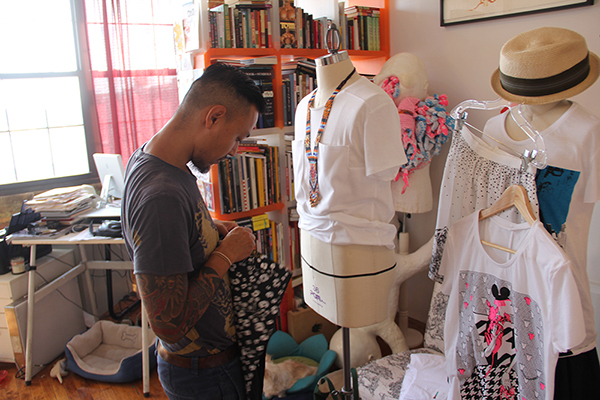
For the past several weeks, I've been working on refining some modified T shirts that I designed. I've been wanting, for a very long time, to venture into fashion - not as a career shift, but moreso to introduce this as another component to my studio practice. Many people have asked me in reference to my wanting to create cut & sew T shirts, why I don't purchase them from a manufacturer and then silkscreen my images onto them. It's a legitimate question, and one that I think comes up naturally in reference to me because I am an illustrator, whose strength is rooted in drawing. Sewing for me, is still very new; although I do love the process of it, I still have much to learn. And so, after answering out loud (and to myself) this question many times over, I realized that my choice has less to do with practicality at this point, and everything to do with realizing a dream. I've written these words before:  
I love the craft of making things. 
I care about my studio practice.
This is not to suggest that I would never source out part of my work; I would be stubborn not to do so, if ever the demand became too large for me to manage. To share, I currently have a sewer, and an assistant, as well as interns who have helped me tremendously throughout this process. But at this point, if I continue to receive help and source out more of my process, then I would want to keep the manufacturing within the US. So far, it's been good, and so far I've been able to afford to do so. But I admit that I am spending more than I am making. And in order to make these shirts, and in order to shift some of my time and attention over to creating these shirts, means that I have to give up other things. I've always believed that everything comes at a price, that when you ask for, and then receive something, then you must relinquish something else in return. To do otherwise, inspires greed and self absorption, two characteristics that I despise in people. The notion of give-and-take is something that I take very seriously; for me, nothing is free.

The past two weeks I have been working more than 90 hours per week. 
I write this, not because I am proud. It's only a statement to describe the effort that it's taken me to try to do all of the work. For me, the work was necessary, because choosing to do it any other way, would not have been possible, at least with my current resources and income.
Over the past 14 or so days, I had a kind of daily ritual: I would wake very early in the morning, between 4:15am to 5:00am; I would shower and get changed, and then walk the dogs to the studio. Rita, who is the older of the two dogs,  I would carry most of the time -- without trying to humanize her, I figure that it's probably too early for her to walk based on the fact that she just sits on the sidewalk when we get outside. In any event, my work days have been lasting between 12-16 hours everyday, including the weekends, such that I split my days up to accommodate both illustration and fashion related work.
It's a strange feeling to work so hard for something and then arrive at a place where you suddenly forget the reasons why you began in the first place. It's the repetition of tasks, and those moments when I spend alone in silence, making whatever it is I am making without any feedback from anyone that causes me to forget what my original intentions were for choosing to place so much time and effort in making these T shirts. 
And so, I find myself 
pausing, 
and listening, 
and watching 
for some sign to remind myself that all of my pursuits carry with it good intentions, and contain some value of worth.

* The T shirts above are from my line YEE YEE. My focus for the Fall are on Graphic Tees. They're currently on sale on fab.com.

Tuesday, September 4, 2012

Process Silkscreen 02: Creating Transparencies

video
Oooops. I made a mistake. No worries. I'll fix'em up.